

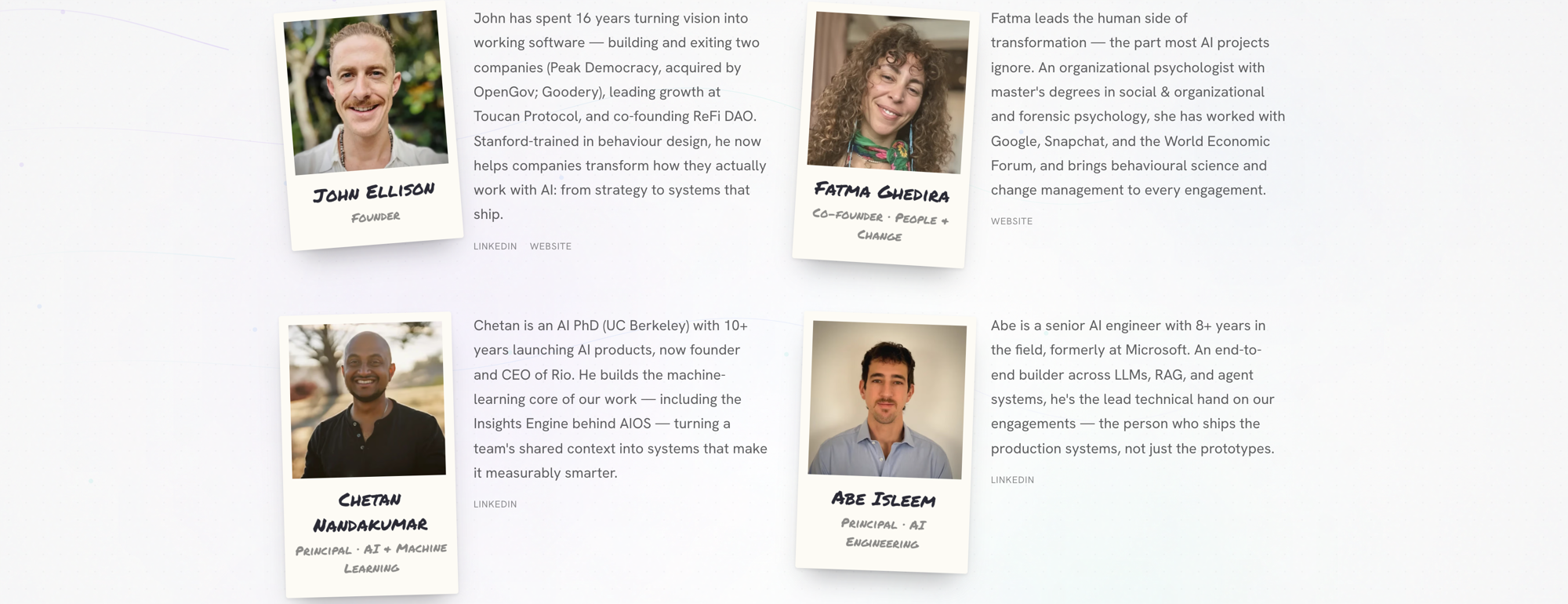
After eight weeks of working full-time with an incredibly talented agentic engineer, Chetan Nandakumar, I'm excited to release AIOS: an open-source operating system for agentic teams.
Join the Journey
Get weekly insights on AI transformation and regenerative wisdom delivered straight to your inbox. No noise, just signal.
Join 800+ readers. Unsubscribe anytime.
What is AIOS?
AIOS is a second brain for agentic teams, built in two parts.
First, a structured workspace for each person on your team. It runs on your own machine and gives an agent the conventions and guardrails it needs to do real operational work: manage communications, coordinate with team members, track tasks, and build anything with agents.
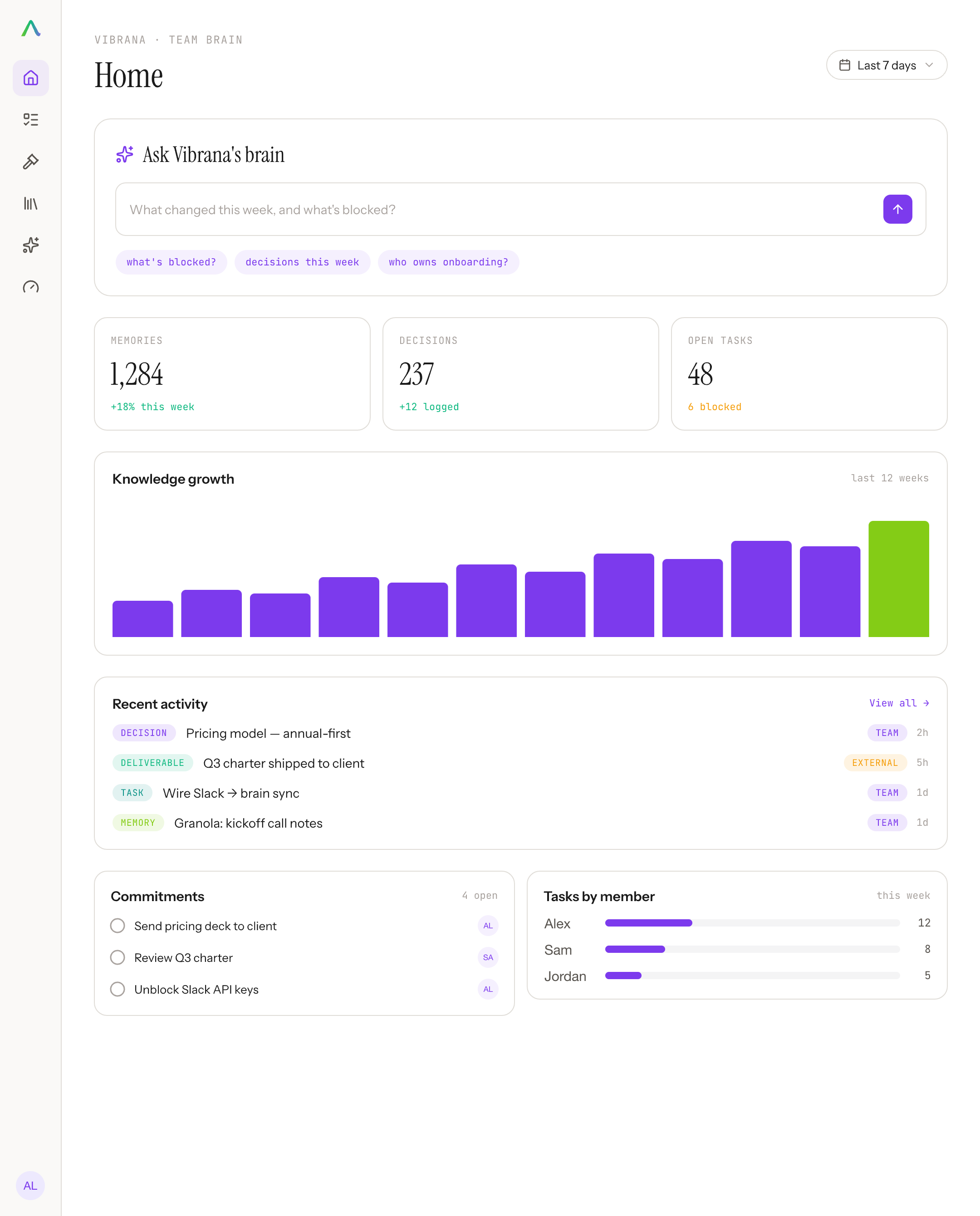
Second, a shared Team Brain. It receives tagged pushes from every workspace and turns them into shared memory, tasks, decisions, deliverables, queryable in plain English. It also integrates with all your existing tools, gaining passive context about the work you and your team do.
The result: instead of ten people carrying ten different versions of the same week, the team has one clear version of the truth. An executive can easily see what's happening across the entire organization and dive into any specific areas that seem out of place.
How does it work?
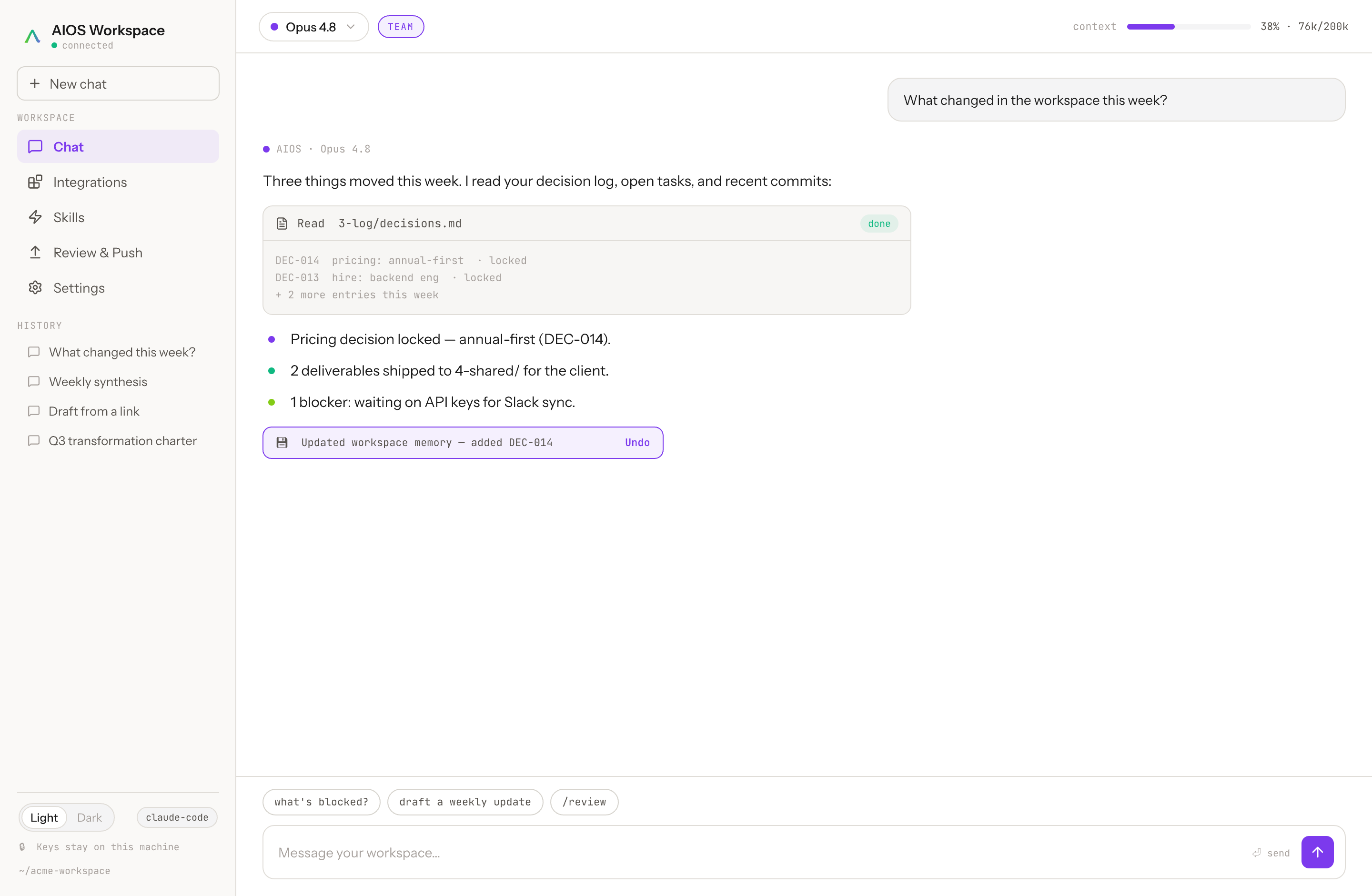
Every workspace tags what it creates as private, team, or external. Nothing leaves your machine unless you push it. The tag decides where it goes.
It's two repos, one system: aios-workspace for the individual, aios-team-brain for the team. It's MIT-licensed and self-hosted. It runs on top of whatever you already use, Claude Code, Cursor, Codex, Openclaw or Hermes.
AIOS doesn't replace your runtime. It gives the work you do in it a shape the rest of the team can share.
Managing codebases
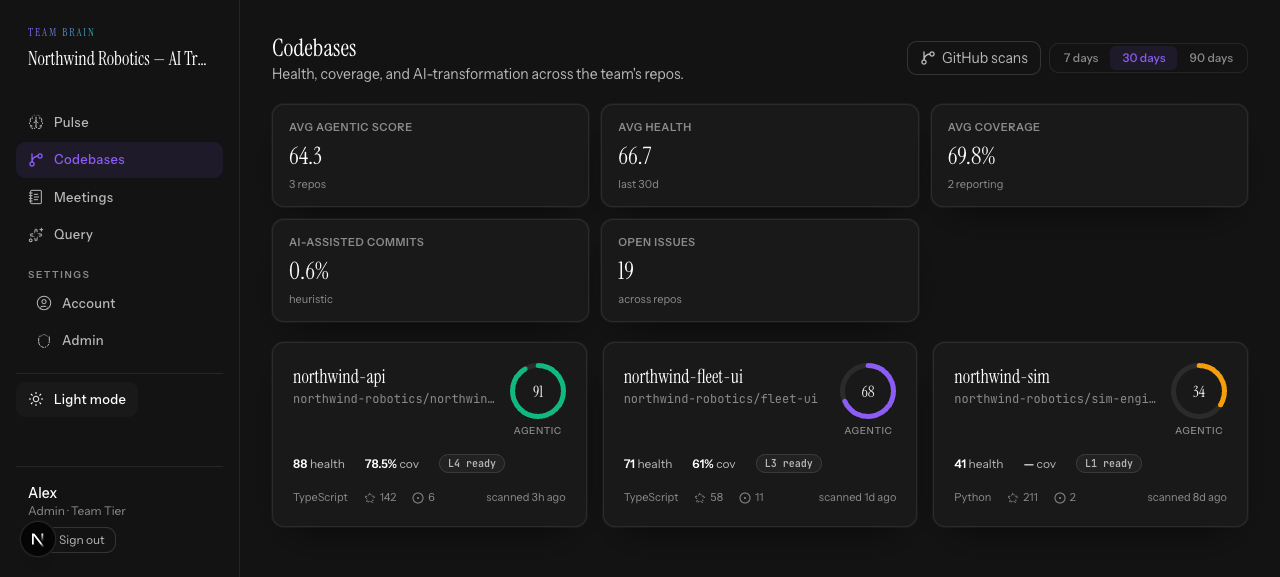
AIOS also watches the health of every codebase your team ships against.
Point the scanner at a repo (aios-ingest scan, or a POST to the brain's API) and it comes back with two numbers and a badge, not a vibe. A health score: test coverage, commit cadence, and open-issue load, weighted and combined. An agentic score: the same, plus whether the repo actually has the scaffolding an agent needs to work in it well, a CLAUDE.md or AGENTS.md, skills, slash commands, and how much of its recent commit history was AI-assisted. And a readiness badge, L0 through L5, scored against a rubric of concrete, file-existence checks: does this repo have tests wired to CI, a linter, docs, a one-command setup.
None of it is a guess dressed up as a score. Every number traces back to something checkable in the repo itself, and a stale badge shows up the moment a codebase hasn't been rescanned in two weeks. It's the same discipline AIOS applies to a person's workflow, applied to the codebase they're shipping into.
How mature is your team, really?
AIOS scores agentic maturity itself for a person and for a team against a model we call agentic engineering maturity: five levels, from prompting a chatbot and taking what it gives you, up to running fleets of agents in parallel with real verification loops. The levels aren't about how much AI you use. They're about whether you can trust what it produces, and whether your setup gets better on its own or you're solving the same problem every week.
A team's score isn't a vanity number. It's a diagnostic: which of five specific capabilities, verification, context hygiene, autonomy, learning, cost control, is the actual bottleneck, so the next thing you fix is the right thing.
Who's it for?
Teams already working with agents, where coordination has become the real problem. Contributors moving at wildly different speeds. Context that balloons differently for every person. Nobody sure what's actually true right now.
AIOS is for teams that want everyone working agentically, terminal-comfortable or not, without splitting into a fast group and a left-behind group.
Try it: Quickstart guide · AIOS site Build on it: aios-workspace on GitHub · aios-team-brain on GitHub Read more: The canonical writeup
The backstory
Here's the backstory, if you want it.
I started building products with AI back in 2025, for one of my clients. I shipped two products in two weeks. That's when it hit me: this way of working was going to change how teams operate, full stop. The lines between product, engineering, and design don't hold up when one person with an agent can do all three in an afternoon.
A few months later, a CEO of a mid-market company asked me to run a 12-week AI transformation program across the whole organization. Not a pilot in one team. Everyone.
What the engagement actually taught me
Twelve weeks is not enough time to give a hundred-plus people a new operating model and have it stick. So I did the thing you do under that kind of pressure: I built the system I needed for myself and my own small team first, then used it to run the engagement.
It ended up being a structured workspace. Everyone worked out of the same shape of repository: shared context, a shared spine of folders, and logs, real logs, of the facts, events, tasks, and decisions that actually happened that week. Not a status doc someone wrote up after the fact. A record an agent could read and act on directly.
Somewhere in the middle of that engagement I realized this wasn't a tooling choice. It was a different paradigm for working with agents entirely. An individual with an agent is fast. A team of individuals, each with their own agent and no shared record of what's true, is not a faster team. It's five people producing five versions of the same week.
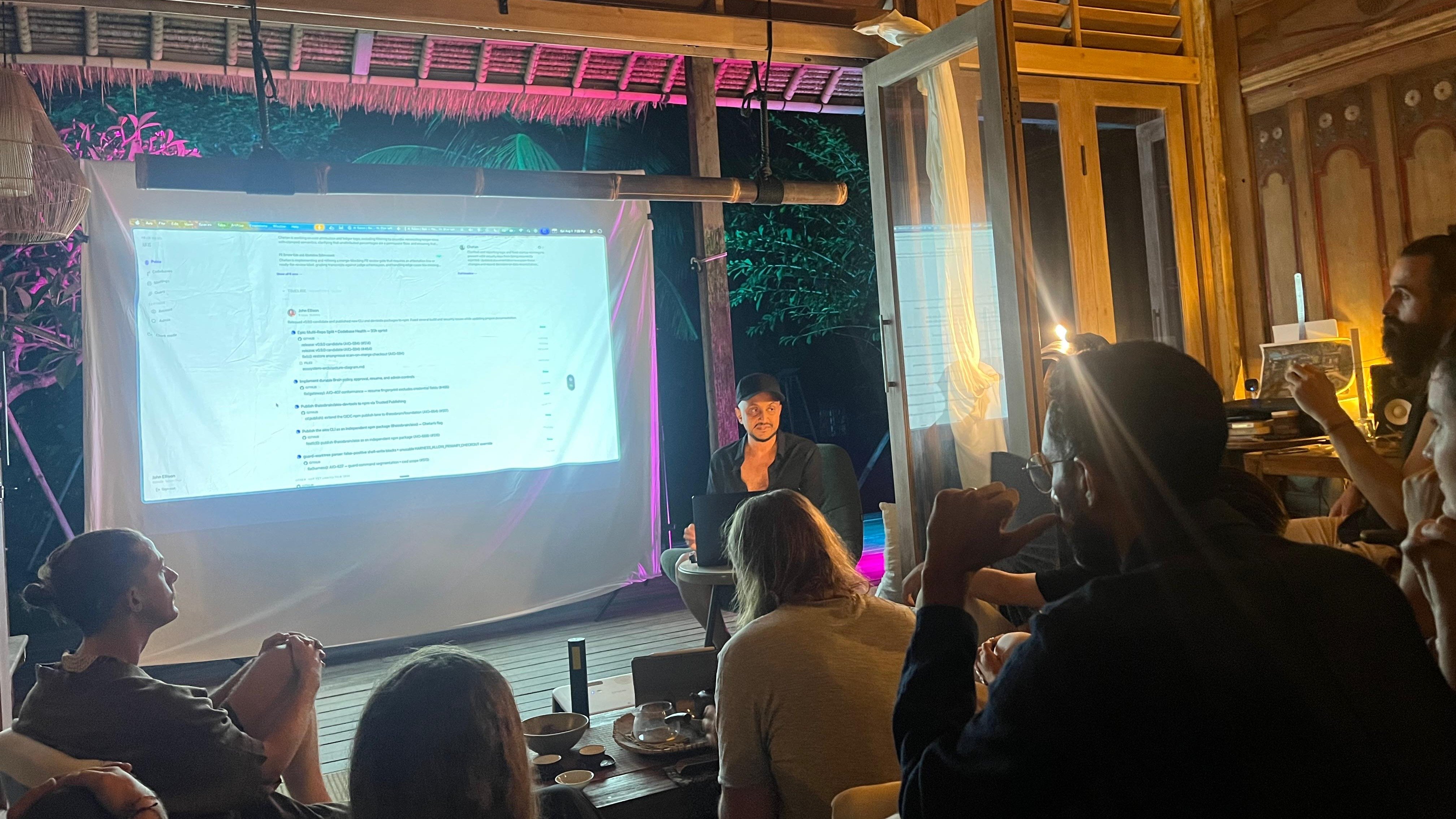
Meeting Chetan
After the engagement wrapped, I met Chetan Nandakumar. We started talking about whether the thing I'd built out of necessity, for one engagement, could be a real product. Eight weeks later, it was.
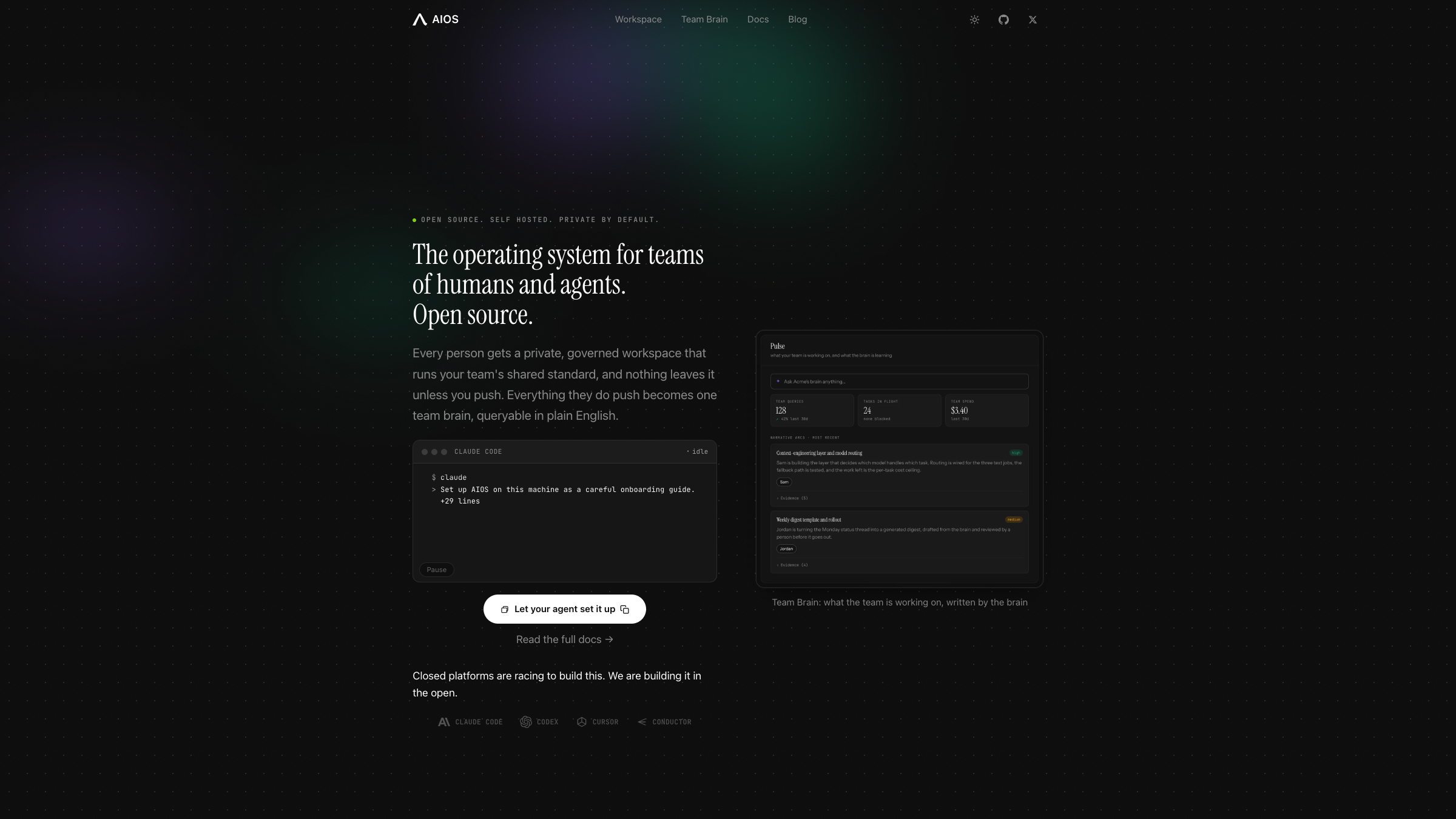
It's public today
We shared it quietly with a small group first. As of today both repos are open and anyone can try it. It's an alpha, it's rough in places, and I'd rather hear where it breaks than wait until it looks finished.
The canonical writeup, with the full picture of how the workspace and the Team Brain fit together and why the individual-agent boom (OpenClaw and everything after it) doesn't automatically make a team faster, lives on the AIOS site: Introducing AIOS.
If you're running a team on agents right now and feel the same thing I did on that engagement, five people moving fast in five different directions, I'd genuinely like to hear about it.


