

Spending thousands on tokens? What if you could get frontier model performance at 1.7% of the cost?
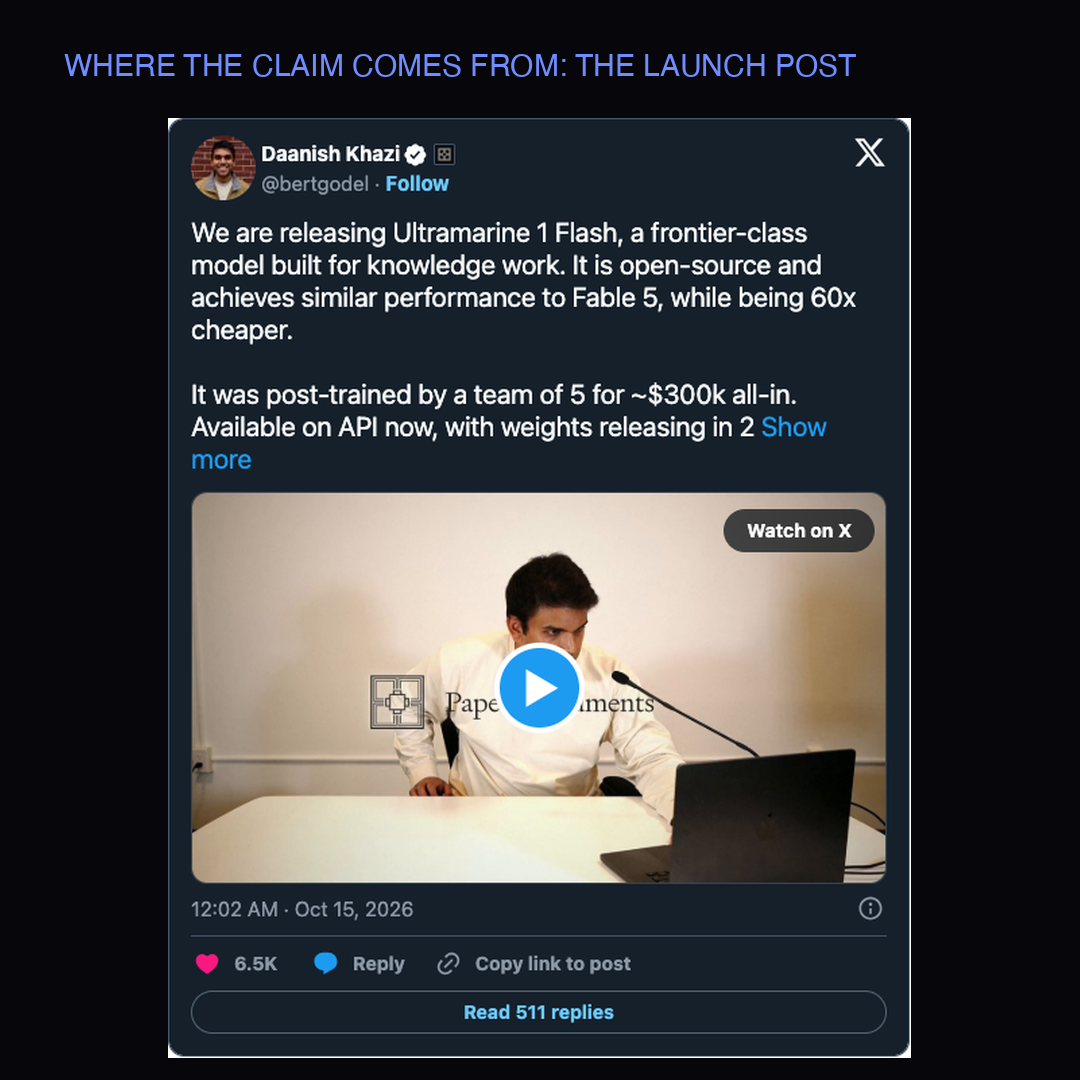
A five-person team says its model matches Fable 5 on knowledge work at 60x lower cost. Would you move your company's work onto it on that claim?
Join the Journey
Get weekly insights on AI transformation and regenerative wisdom delivered straight to your inbox. No noise, just signal.
Join 800+ readers. Unsubscribe anytime.
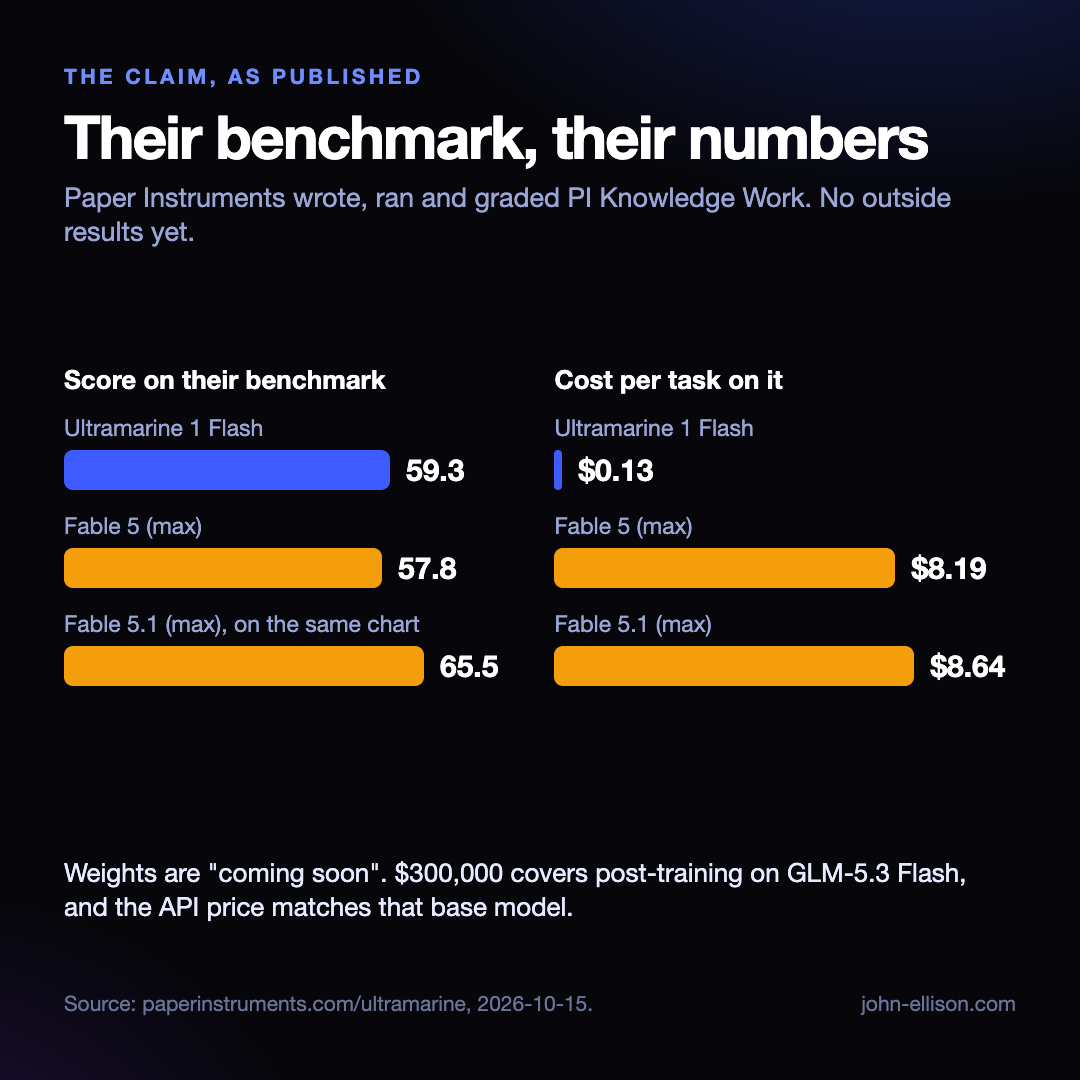
Ultramarine 1 Flash scores 59.3 against 57.8 for Fable 5, at $0.13 a task versus $8.19. Paper Instruments says five people post-trained it for about $300,000.
Here is what the launch doesn't say... They built the benchmark, ran it and published it. The weights are "coming soon," so "open-source" is just a promise (one that I am hopeful for). The $300,000 is post-training on top of an existing base model, GLM-5.3 Flash, and the API price is the same as that base model's. On their own chart, Fable 5.1 scores 65.5.
None of that makes it a bad model. It may be excellent. Until it's tested, though, a 60x claim is just a claim. I've tested a lot of these new open source models on real work in a 'fan-out' approach with an evaluator and to be honest, I've been very disappointed by the validity of a lot of these claims. Don't get me wrong, I use open source models all the time, but closed-source frontier models are still my main workhorse for the toughest work.
What I tested
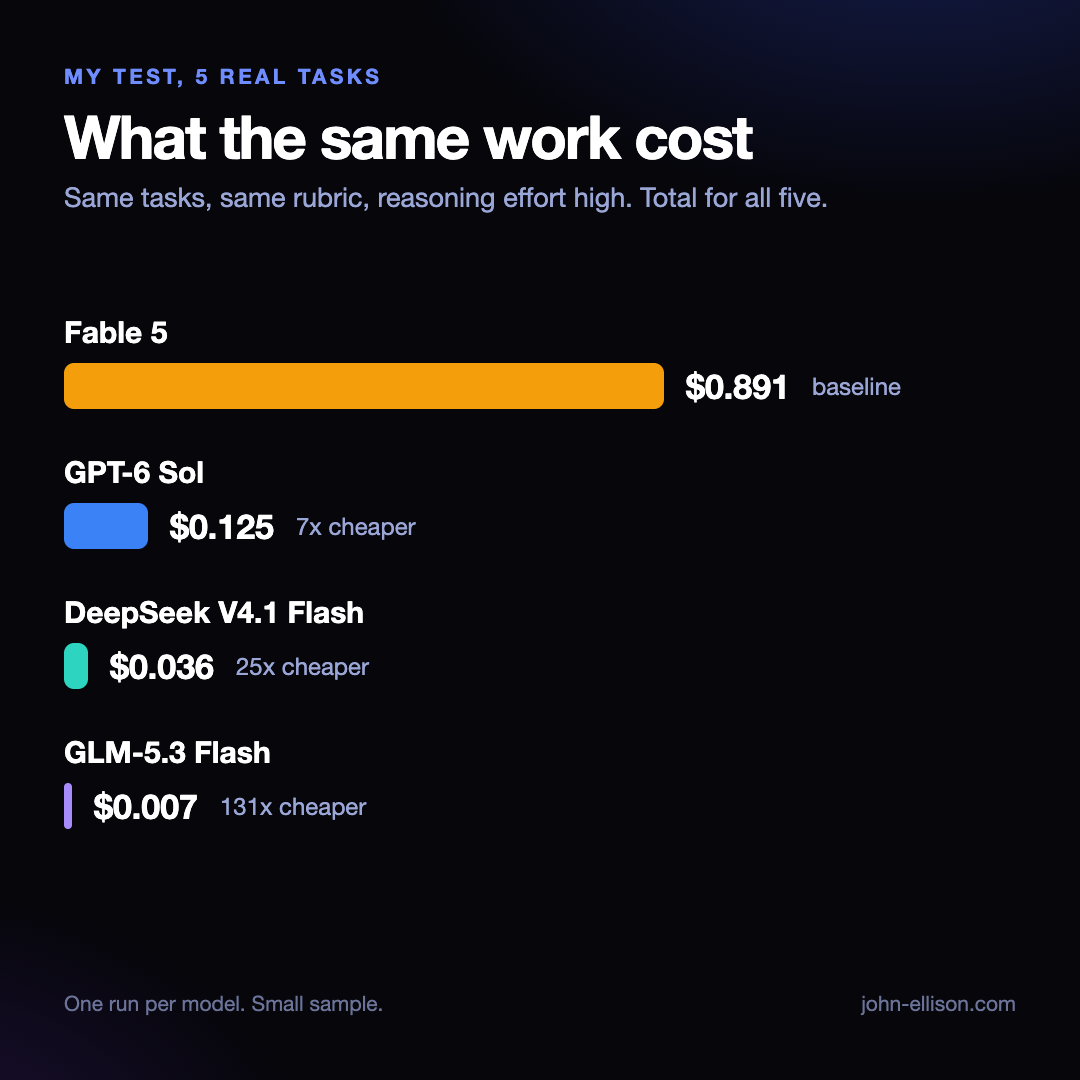
So I ran a test of my own on what I could reach. Five real tasks from my own Linear board (a voice card, bios, a one-pager, a bug fix checked by hidden tests, a leave-behind), run on Fable 5, GPT-6 Sol, DeepSeek V4.1 Flash and GLM-5.3 Flash, the model Ultramarine is built on. I wrote the rubrics first, and a blind judge that wasn't one of the four scored the writing.
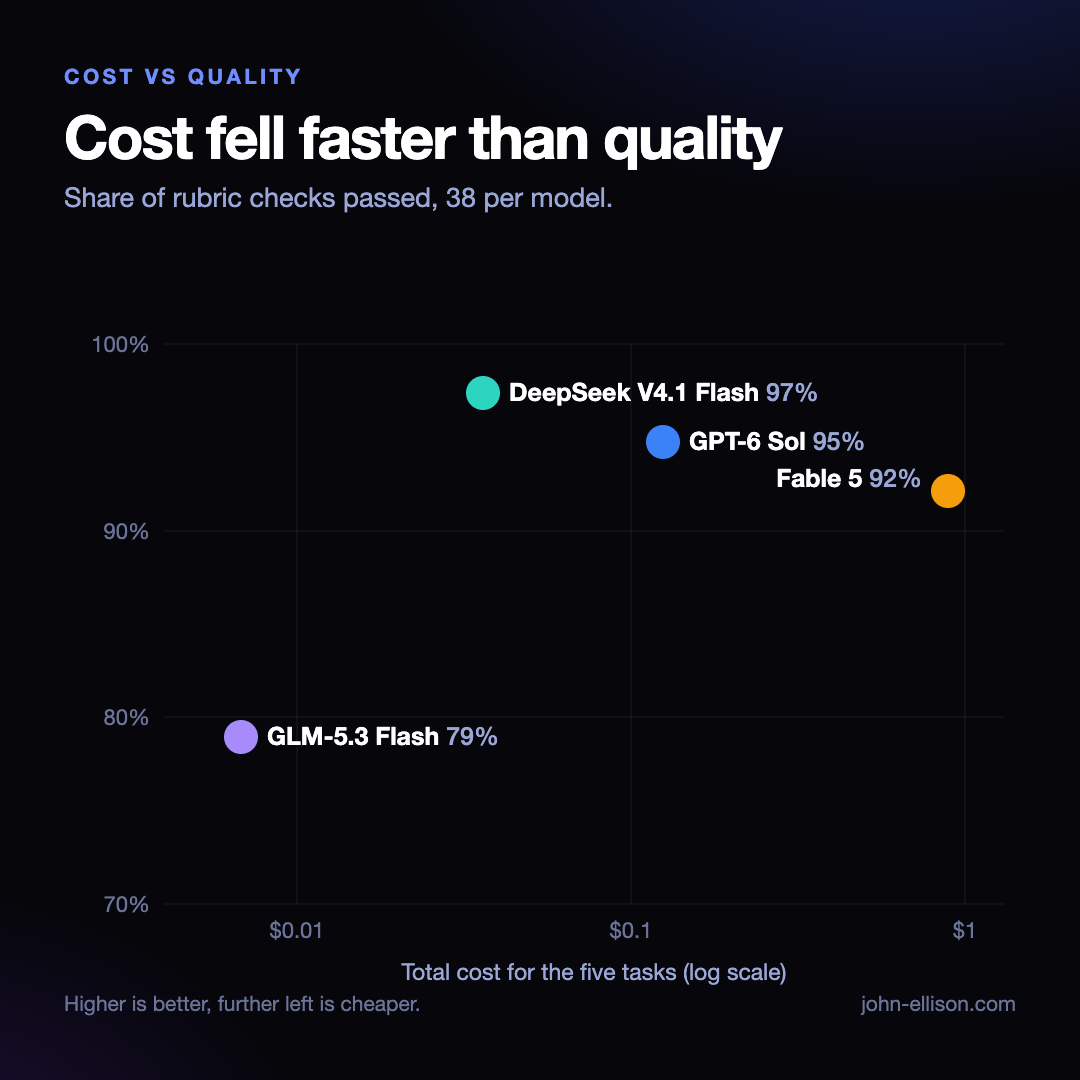
The same work cost $0.89 on Fable 5 and under a penny on GLM, 131x less. Quality moved far less than cost. GPT-6 Sol and DeepSeek scored level with Fable on these tasks, and only the GLM base slipped. That slip is the gap Ultramarine says post-training closes.
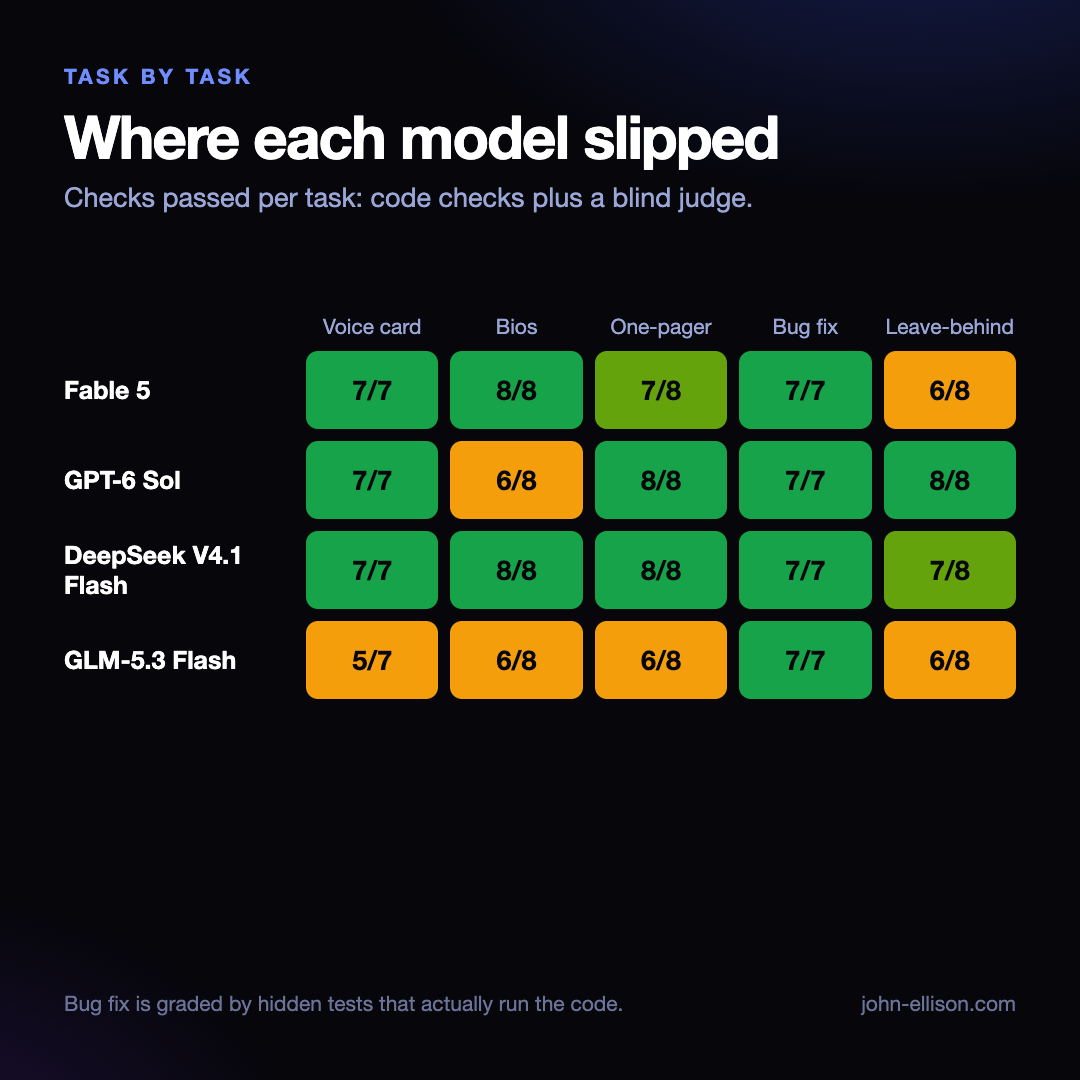
Ultramarine itself isn't in these numbers, and I'd push on that. The launch post says "Available on API now." When I signed up on October 15, I got "You're on the waitlist." The weights are "coming soon," and the model isn't on OpenRouter, Hugging Face or any other provider. A 60x claim that nobody outside the lab can run is pretty bad marketing. Open the doors first, then publish the chart. Seriously.
Five small tasks, one run each, so read a one-check gap as noise. I'd rather show you a half-finished test than quote their chart.
Test it on your own work
Before I switch anything I want a result from someone who didn't write the test, run on my own documents, with cost per finished task and the same reasoning effort on every model. Once you have access, an agent can do most of that in an evening.
Open Claude Code or Codex in a folder with five real tasks from your own work and paste this:
Test Ultramarine 1 Flash against Fable 5 and the strongest OpenAI model on the five tasks in ./tasks. No mocks and no invented numbers. If any key is missing or any call fails, stop and tell me.
- For each task, write a pass/fail rubric before running any model.
- Run every task on all three at the same reasoning effort, and tell me which one you used. Ultramarine: OpenAI-compatible API at https://api.paperinstruments.com/v1, model ultramarine-1-flash, key in PAPERINSTRUMENTS_API_KEY. Fable 5: claude -p. OpenAI: codex exec with the best model my account allows.
- Save every raw output, plus the real token usage and cost each tool reports (for Ultramarine, set stream_options include_usage). If a tool reports tokens but no dollars, price them from the published rates and say so.
- Have a fourth model that is none of the three score the outputs blind, labeled A, B and C.
- Give me one table: score, cost per finished task and time per task. Flag every run that errored or was cut off (finish_reason: length).
I ran this prompt through fresh agents to check it. It stops cleanly when a key is missing, and it runs through to the table.
Why those rules: agents will happily fake a benchmark if you let them, and Ultramarine bills reasoning tokens at the output rate, so cost per finished task is the number that matters.
When I pick a model for a pipeline, I run three to five on real inputs and evaluate quality, speed and cost per task. A launch chart never tells us what a model does to my files.
What evidence would get you to switch to an open source model as your workhorse?
Sources
- The launch post on X
- Ultramarine 1 Flash, Paper Instruments: the release and benchmark page
- An independent read that points out the GLM-5.3 Flash base (worth knowing the publisher sells access to that base model)
- The Ultramarine API docs


